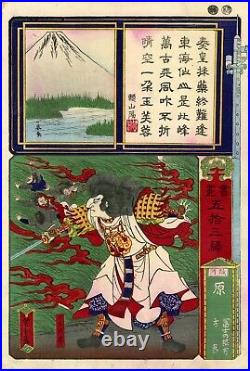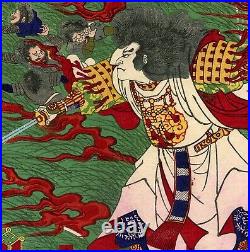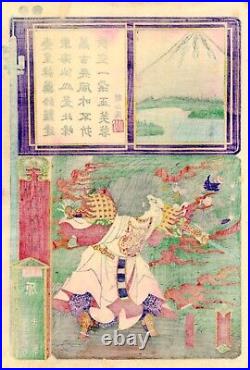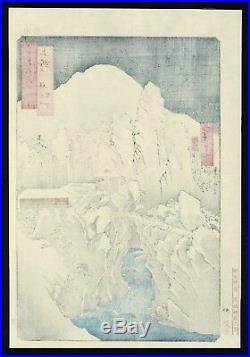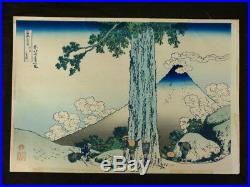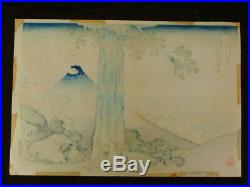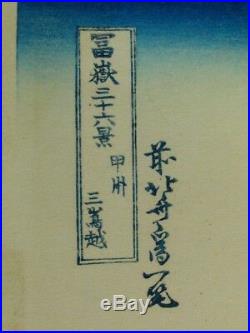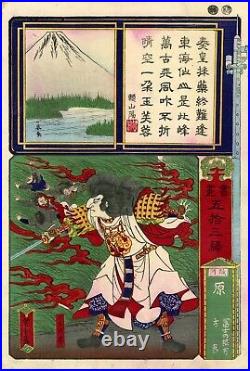
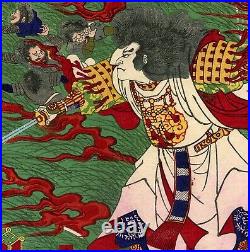
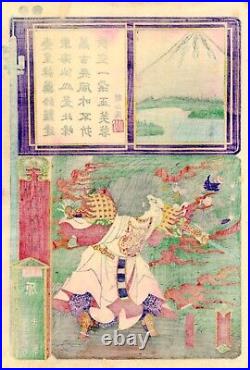
The woodblock print is a Japanese ukiyo-e print from the Meiji era. The inscription on the print reads “? ” (Kojima Takashige Nishiki to). This text suggests the print depicts Kojima Takanori and the brocade banner. This particular print is from the series “Twenty-four Generals of the Kai Province, ” and it was created by the artist Utagawa Yoshikazu. It is a scene from the Sengoku period, depicting the warrior Kojima Takanori. Artist and Series Information. Series: Twenty-four Generals of the Kai Province. Subject: Kojima Takanori and the brocade banner. Please view all the photos as they form an integral part of the description. We appreciate your business.
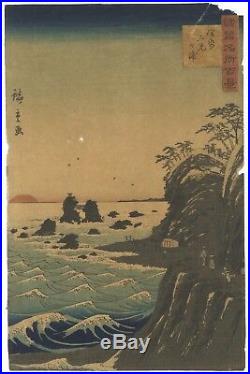
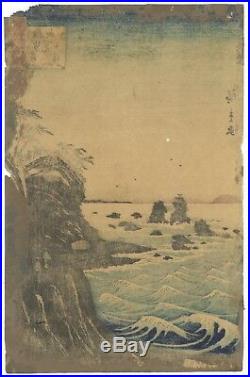
SATSUMA Province Utagawa Hiroshige Japanese Woodblock Framed Art Print 18×15. PROVINCE DE SATSUMA BO NO URA, LA ROCHE DES DEUX GLAIVES “Two-Sword Rocks” in Bo Bay, Satsuma Province (present-day Kagoshima Prefecture) It is a very beautiful re-print of the original. This is one in a series of 69 prints. As of this listing, I have 35 of them, all professionally framed in a brushed silver toned frame and matted in black They all came from the same Estate in Louisville, KY. All are in excellent condition and any one or all of them would add greatly to your Asian art collection. The last 5 pictures are from one of these that had a damaged back. I deconstructed it so you could see all the layers and materials involved. Depicts the “Two-Sword Rocks” in Bo Bay, Satsuma Province (present-day Kagoshima Prefecture). The series showcases famous locations from each of Japan’s provinces. Created in vertical format, a novel approach for landscape prints at the time. Published serially between 1853 and 1856. Known for its use of bokashi (gradation printing). Reflects the increasing interest in travel and pilgrimage during the Edo period. Served as both aesthetic pieces and geographical guides. Born in Edo as Tokutaro Ando, Hiroshige Utagawa grew up in a minor samurai family. His father belonged to the firefighting force assigned to Edo Castle. It is here that Hiroshige was given his first exposure to art: legend has it that a fellow fireman tutored him in the Kano school of painting, though Hiroshige’s first official teacher was Rinsai. Though Hiroshige tried to join Toyokuni Utagawa’s studio, he was turned away. In 1811, young Hiroshige entered an apprenticeship with the celebrated Toyohiro Utagawa. After only a year, he was bestowed with the artist name Hiroshige. He soon gave up his role in the fire department to focus entirely on painting and print design. During this time he studied painting, intrigued by the Shijo school. Hiroshige’s artistic genius went largely unnoticed until 1832. With the Tokugawa Shogunate relaxing centuries of age-old restrictions on travel, urban populations embraced travel art and Hiroshige Utagawa became one of the most prominent and successful ukiyo-e artists. He also produced kacho-e (bird-and-flower pictures) to enormous success. In 1858, at the age of 61, he passed away as a result of the Edo cholera epidemic. Hiroshige Utagawa’s woodblock prints continue to convey the beauty of Japan and provide insight into the everyday life of its citizens during the Edo period. The appeal of his tender, lyrical landscapes was not restricted to the Japanese audience. Hiroshige’s work had a profound influence on the Impressionists and Post-Impressionists of Europe: Toulouse-Lautrec was fascinated with Hiroshige’s daring diagonal compositions and inventive use of perspective, while Van Gogh literally copied two of Hiroshige’s prints from the famous series, 100 Famous Views of Edo in oil paint. Hiroshige (1797 – 1858). Mimasaka Province, Yamabushi Valley. Series: Famous Places in the 60-odd Provinces. Size (H x W): 14.5 x 10.75 (inches). Publisher: Koshimuraya Heisuke (Koshihei). Seals: Date and Aratame. Condition: Very good color and impression, light soiling and wear, embellished with mica.
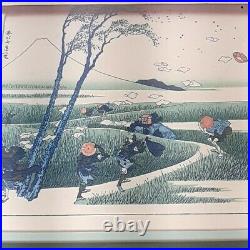
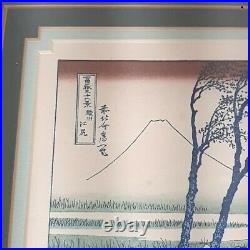
Please check the item specifics as it may contain details which you are looking for. We offer a handpicked collection of high-quality items, available exclusively in the U. Check item specifics and photos to ensure you make the perfect choice. While we strive to offer detailed images, it’s not always possible to verify every aspect of the item. Therefore, we apologize if the product does not meet your expectations.
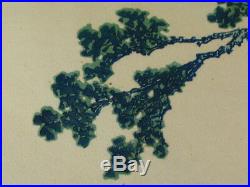
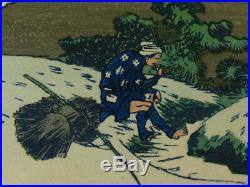
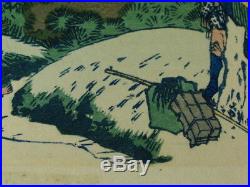
Ishizuchi, Iyo Province – Fudo Myoo Bonji Woodblock. We are open to reasonable offers on this item. Don’t hesitate to send us your best offer! We strive to provide our valued customers with the best possible experience. Our store is located in Toyama, Japan. We will help you to find what you are looking for by searching all over Japan. For any questions and clarifications, please do not hesitate to reach out to us anytime. International buyers – please note. We’re happy to help!
OKI Province Utagawa Hiroshige Japanese Woodblock Framed Art Print 18×15. PROVINCE D’ OKI LE ANCTUAIRE DE TAKUHI (Oki Province, Takuhi Shrine) It is a very beautiful re-print of the original. This is one in a series of 69 prints. As of this listing, I have 35 of them, all professionally framed in a brushed silver toned frame and matted in black They all came from the same Estate in Louisville, KY. All are in excellent condition and any one or all of them would add greatly to your Asian art collection. The last 5 pictures are from one of these that had a damaged back. I deconstructed it so you could see all the layers and materials involved. The image is a woodblock print titled “Oki Province, Takuhi Shrine” by Utagawa Hiroshige, part of the “Famous Views of the Sixty-odd Provinces” series. Series: “Famous Views of the Sixty-odd Provinces” (Rokujuyoshu Meisho Zue). Depicts: Takuhi Shrine in Oki Province, a significant shrine dedicated to the gods of the sea. Technique: Woodblock print (ukiyo-e), using ink and color on paper. Influence: Part of a series that influenced European Impressionists. Born in Edo as Tokutaro Ando, Hiroshige Utagawa grew up in a minor samurai family. His father belonged to the firefighting force assigned to Edo Castle. It is here that Hiroshige was given his first exposure to art: legend has it that a fellow fireman tutored him in the Kano school of painting, though Hiroshige’s first official teacher was Rinsai. Though Hiroshige tried to join Toyokuni Utagawa’s studio, he was turned away. In 1811, young Hiroshige entered an apprenticeship with the celebrated Toyohiro Utagawa. After only a year, he was bestowed with the artist name Hiroshige. He soon gave up his role in the fire department to focus entirely on painting and print design. During this time he studied painting, intrigued by the Shijo school. Hiroshige’s artistic genius went largely unnoticed until 1832. With the Tokugawa Shogunate relaxing centuries of age-old restrictions on travel, urban populations embraced travel art and Hiroshige Utagawa became one of the most prominent and successful ukiyo-e artists. He also produced kacho-e (bird-and-flower pictures) to enormous success. In 1858, at the age of 61, he passed away as a result of the Edo cholera epidemic. Hiroshige Utagawa’s woodblock prints continue to convey the beauty of Japan and provide insight into the everyday life of its citizens during the Edo period. The appeal of his tender, lyrical landscapes was not restricted to the Japanese audience. Hiroshige’s work had a profound influence on the Impressionists and Post-Impressionists of Europe: Toulouse-Lautrec was fascinated with Hiroshige’s daring diagonal compositions and inventive use of perspective, while Van Gogh literally copied two of Hiroshige’s prints from the famous series, 100 Famous Views of Edo in oil paint. Hiroshige (1797 – 1858). Mimasaka Province, Yamabushi Valley. Series: Famous Places in the 60-odd Provinces. Size (H x W): 14.5 x 10.75 (inches). Publisher: Koshimuraya Heisuke (Koshihei). Seals: Date and Aratame. Condition: Very good color and impression, light soiling and wear, embellished with mica.
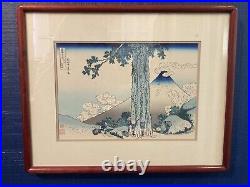
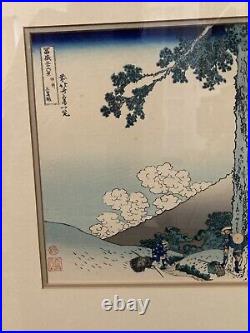
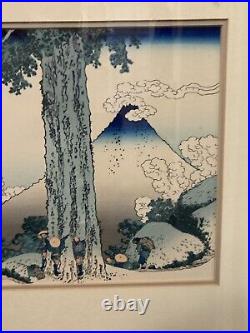
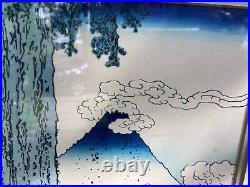
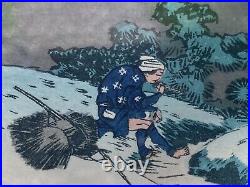
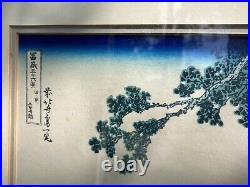
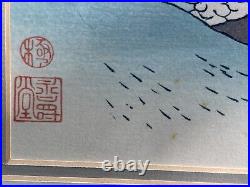
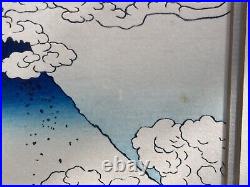
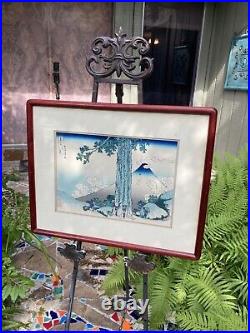
Vintage Katsushika Hokusai Authentic Woodblock Print “Yoro Waterfall in Mino Province” by the Adachi institute specializing in preserving ancient woodblock layered technics.
SANUKI Province Utagawa Hiroshige Japanese Woodblock Framed Art Print 18×15. It is a very beautiful re-print of the original. This is one in a series of 69 prints. As of this listing, I have 35 of them, all professionally framed in a brushed silver toned frame and matted in black They all came from the same Estate in Louisville, KY. All are in excellent condition and any one or all of them would add greatly to your Asian art collection. The last 4 pictures are from one of these that had a damaged back. I deconstructed it so you could see all the layers and materials involved. The image is a woodcut print titled “Sanuki Province, Distant View of Mount Zozu” from the series “Famous Views of the Sixty-odd Provinces” by Utagawa Hiroshige. Series: Famous Views of the Sixty-odd Provinces. Subject: Mount Zozu in Sanuki Province, with pilgrims or travelers in the foreground. Publisher: Koshimuraya Heisuke (Koshihei). Seals: Aratame and date seal, Hori Soji. Born in Edo as Tokutaro Ando, Hiroshige Utagawa grew up in a minor samurai family. His father belonged to the firefighting force assigned to Edo Castle. It is here that Hiroshige was given his first exposure to art: legend has it that a fellow fireman tutored him in the Kano school of painting, though Hiroshige’s first official teacher was Rinsai. Though Hiroshige tried to join Toyokuni Utagawa’s studio, he was turned away. In 1811, young Hiroshige entered an apprenticeship with the celebrated Toyohiro Utagawa. After only a year, he was bestowed with the artist name Hiroshige. He soon gave up his role in the fire department to focus entirely on painting and print design. During this time he studied painting, intrigued by the Shijo school. Hiroshige’s artistic genius went largely unnoticed until 1832. With the Tokugawa Shogunate relaxing centuries of age-old restrictions on travel, urban populations embraced travel art and Hiroshige Utagawa became one of the most prominent and successful ukiyo-e artists. He also produced kacho-e (bird-and-flower pictures) to enormous success. In 1858, at the age of 61, he passed away as a result of the Edo cholera epidemic. Hiroshige Utagawa’s woodblock prints continue to convey the beauty of Japan and provide insight into the everyday life of its citizens during the Edo period. The appeal of his tender, lyrical landscapes was not restricted to the Japanese audience. Hiroshige’s work had a profound influence on the Impressionists and Post-Impressionists of Europe: Toulouse-Lautrec was fascinated with Hiroshige’s daring diagonal compositions and inventive use of perspective, while Van Gogh literally copied two of Hiroshige’s prints from the famous series, 100 Famous Views of Edo in oil paint. Hiroshige (1797 – 1858). Mimasaka Province, Yamabushi Valley. Series: Famous Places in the 60-odd Provinces. Size (H x W): 14.5 x 10.75 (inches). Seals: Date and Aratame. Condition: Very good color and impression, light soiling and wear, embellished with mica.
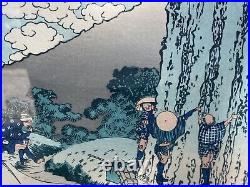
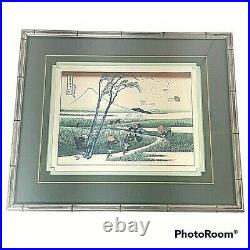
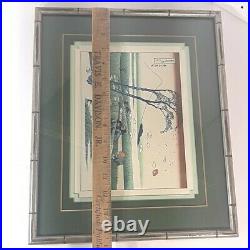
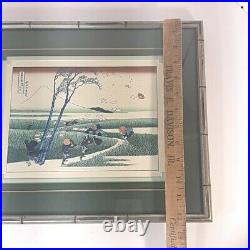
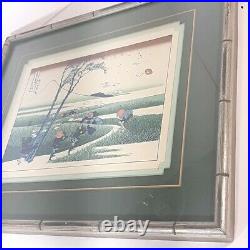
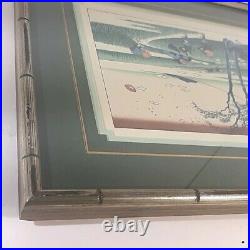
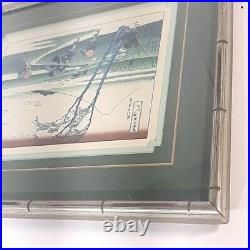
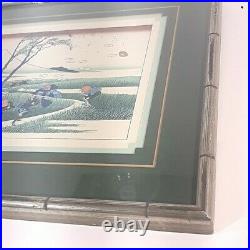
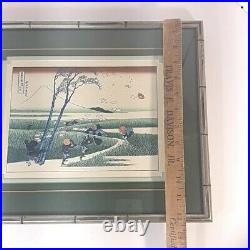
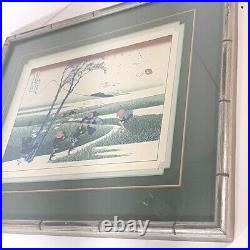
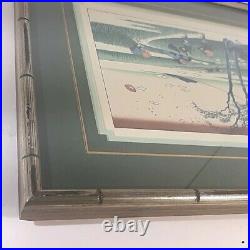
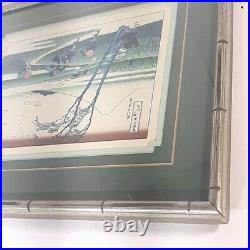
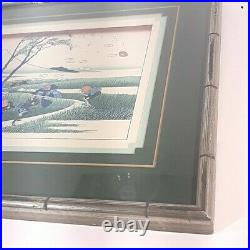
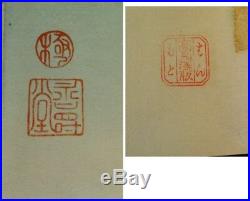
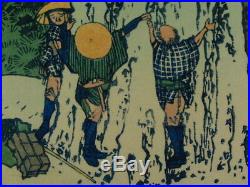
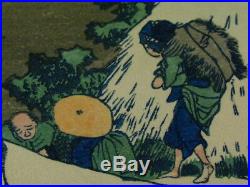
Mimasaka Province Utagawa Hiroshige Japanese Woodblock Framed Art Print 18×15. This is one in a series of 69 prints. As of this listing, I have 35 of them, all professionally framed and matted. They all came from the same Estate in Louisville, KY. All are in excellent condition and any one or all of them would add greatly to your Asian art collection. Mimasaka Province: Yamabushi Valley (Mimasaka, Yamabushidani), from the series “Famous Places in the Sixty-odd Provinces (Rokujuyoshu meisho zue)”. The wind drives torrents of rain in bold, grey sheets as travelers brace themselves against storm in Yamabushi Valley. On the riverbank one figure holds onto his hat, but it’s too late for the other. He watches, arm outstretched as the wind carries it away. On the rippling surface of the Yoshii River, a third figure hunches over against the wind. As Hiroshige’s sweeping lines evoke the movement and intensity of the storm, the sparkle of mica in the dark sky and shadows adds to the stormy atmosphere. Today, the former Mimasaka Province belongs to northeastern Okayama Prefecture. Born in Edo as Tokutaro Ando, Hiroshige Utagawa grew up in a minor samurai family. His father belonged to the firefighting force assigned to Edo Castle. It is here that Hiroshige was given his first exposure to art: legend has it that a fellow fireman tutored him in the Kano school of painting, though Hiroshige’s first official teacher was Rinsai. Though Hiroshige tried to join Toyokuni Utagawa’s studio, he was turned away. In 1811, young Hiroshige entered an apprenticeship with the celebrated Toyohiro Utagawa. After only a year, he was bestowed with the artist name Hiroshige. He soon gave up his role in the fire department to focus entirely on painting and print design. During this time he studied painting, intrigued by the Shijo school. Hiroshige’s artistic genius went largely unnoticed until 1832. With the Tokugawa Shogunate relaxing centuries of age-old restrictions on travel, urban populations embraced travel art and Hiroshige Utagawa became one of the most prominent and successful ukiyo-e artists. He also produced kacho-e (bird-and-flower pictures) to enormous success. In 1858, at the age of 61, he passed away as a result of the Edo cholera epidemic. Hiroshige Utagawa’s woodblock prints continue to convey the beauty of Japan and provide insight into the everyday life of its citizens during the Edo period. The appeal of his tender, lyrical landscapes was not restricted to the Japanese audience. Hiroshige’s work had a profound influence on the Impressionists and Post-Impressionists of Europe: Toulouse-Lautrec was fascinated with Hiroshige’s daring diagonal compositions and inventive use of perspective, while Van Gogh literally copied two of Hiroshige’s prints from the famous series, 100 Famous Views of Edo in oil paint. Hiroshige (1797 – 1858). Mimasaka Province, Yamabushi Valley. Series: Famous Places in the 60-odd Provinces. Size (H x W): 14.5 x 10.75 (inches). Publisher: Koshimuraya Heisuke (Koshihei). Seals: Date and Aratame. Condition: Very good color and impression, light soiling and wear, embellished with mica.
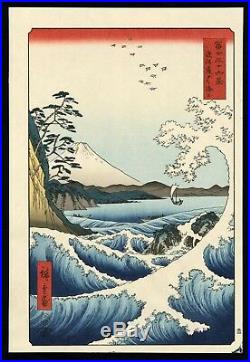
SURUGA Province Utagawa Hiroshige Japanese Woodblock Framed Art Print 18×15. PROVINCE DE SURUGA LA PINEDE DE MIHO (Miho Pine Grove, Suruga Province). It is a very beautiful re-print of the original. This is one in a series of 69 prints. As of this listing, I have 35 of them, all professionally framed in a brushed silver toned frame and matted in black They all came from the same Estate in Louisville, KY. All are in excellent condition and any one or all of them would add greatly to your Asian art collection. The last 5 pictures are from one of these that had a damaged back. I deconstructed it so you could see all the layers and materials involved. Terrific, classic Hiroshige depiction of the Miho pine grove and the beautiful view over Suruga Bay. Mount Fuji rises in the distance, wrapped in mist and capped with a light covering of snow. Boats sail along the river towards Shimizu. Lovely Hiroshige landscape view. Born in Edo as Tokutaro Ando, Hiroshige Utagawa grew up in a minor samurai family. His father belonged to the firefighting force assigned to Edo Castle. It is here that Hiroshige was given his first exposure to art: legend has it that a fellow fireman tutored him in the Kano school of painting, though Hiroshige’s first official teacher was Rinsai. Though Hiroshige tried to join Toyokuni Utagawa’s studio, he was turned away. In 1811, young Hiroshige entered an apprenticeship with the celebrated Toyohiro Utagawa. After only a year, he was bestowed with the artist name Hiroshige. He soon gave up his role in the fire department to focus entirely on painting and print design. During this time he studied painting, intrigued by the Shijo school. Hiroshige’s artistic genius went largely unnoticed until 1832. With the Tokugawa Shogunate relaxing centuries of age-old restrictions on travel, urban populations embraced travel art and Hiroshige Utagawa became one of the most prominent and successful ukiyo-e artists. He also produced kacho-e (bird-and-flower pictures) to enormous success. In 1858, at the age of 61, he passed away as a result of the Edo cholera epidemic. Hiroshige Utagawa’s woodblock prints continue to convey the beauty of Japan and provide insight into the everyday life of its citizens during the Edo period. The appeal of his tender, lyrical landscapes was not restricted to the Japanese audience. Hiroshige’s work had a profound influence on the Impressionists and Post-Impressionists of Europe: Toulouse-Lautrec was fascinated with Hiroshige’s daring diagonal compositions and inventive use of perspective, while Van Gogh literally copied two of Hiroshige’s prints from the famous series, 100 Famous Views of Edo in oil paint. Hiroshige (1797 – 1858). Mimasaka Province, Yamabushi Valley. Series: Famous Places in the 60-odd Provinces. Size (H x W): 14.5 x 10.75 (inches). Publisher: Koshimuraya Heisuke (Koshihei). Seals: Date and Aratame. Condition: Very good color and impression, light soiling and wear, embellished with mica.
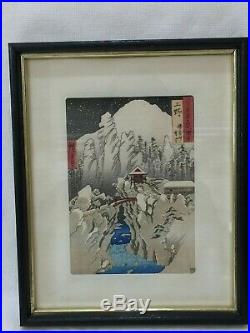
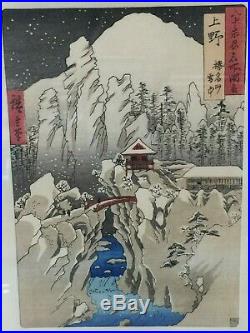
BISHU Province Utagawa Hiroshige Japanese Woodblock Framed Art Print 18×15. PROVINCE DE BISHU GOKEI (GOKEI GORGE). It is a very beautiful re-print of the original. This is one in a series of 69 prints. As of this listing, I have 35 of them, all professionally framed in a brushed silver toned frame and matted in black They all came from the same Estate in Louisville, KY. All are in excellent condition and any one or all of them would add greatly to your Asian art collection. The last 5 pictures are from one of these that had a damaged back. I deconstructed it so you could see all the layers and materials involved. The image is a woodblock print titled “Bitchu Province, Gokei” from the series “Famous Views of the Sixty-odd Provinces” by Utagawa Hiroshige. It was created around 1856. Depicts the Gokei Gorge in Bitchu Province, Japan. Features a vertical composition emphasizing the height and depth of the landscape. Showcases a cascading waterfall between rocky cliffs. Part of a series capturing famous locations throughout Japan. The text on the print reads “Bitchu Gokei” and “Famous Views of the Sixty-odd Provinces”. Born in Edo as Tokutaro Ando, Hiroshige Utagawa grew up in a minor samurai family. His father belonged to the firefighting force assigned to Edo Castle. It is here that Hiroshige was given his first exposure to art: legend has it that a fellow fireman tutored him in the Kano school of painting, though Hiroshige’s first official teacher was Rinsai. Though Hiroshige tried to join Toyokuni Utagawa’s studio, he was turned away. In 1811, young Hiroshige entered an apprenticeship with the celebrated Toyohiro Utagawa. After only a year, he was bestowed with the artist name Hiroshige. He soon gave up his role in the fire department to focus entirely on painting and print design. During this time he studied painting, intrigued by the Shijo school. Hiroshige’s artistic genius went largely unnoticed until 1832. With the Tokugawa Shogunate relaxing centuries of age-old restrictions on travel, urban populations embraced travel art and Hiroshige Utagawa became one of the most prominent and successful ukiyo-e artists. He also produced kacho-e (bird-and-flower pictures) to enormous success. In 1858, at the age of 61, he passed away as a result of the Edo cholera epidemic. Hiroshige Utagawa’s woodblock prints continue to convey the beauty of Japan and provide insight into the everyday life of its citizens during the Edo period. The appeal of his tender, lyrical landscapes was not restricted to the Japanese audience. Hiroshige’s work had a profound influence on the Impressionists and Post-Impressionists of Europe: Toulouse-Lautrec was fascinated with Hiroshige’s daring diagonal compositions and inventive use of perspective, while Van Gogh literally copied two of Hiroshige’s prints from the famous series, 100 Famous Views of Edo in oil paint. Hiroshige (1797 – 1858). Mimasaka Province, Yamabushi Valley. Series: Famous Places in the 60-odd Provinces. Size (H x W): 14.5 x 10.75 (inches). Publisher: Koshimuraya Heisuke (Koshihei). Seals: Date and Aratame. Condition: Very good color and impression, light soiling and wear, embellished with mica.